

Fed Chair de-anchors US long end, but US rate rises likely still coming soon. RBA meanwhile on hold in August, but inflation likely to pressure a further rise later in the year.
Key points
- Chair Warsh’s continued lack of clarity on policy and a reference to possible use of balance sheet tools saw US long end yields higher and the US yield curve steepen sharply. That’s also important for Australian longer-dated yields given the close correlation of the two markets directionally.
- It seems the Fed remains in an information gathering phase, rather than abdicating its policy duties, though those addicted to forward guidance are finding it tough. The message of the US long end seems to clearly be that some firming of US monetary policy is warranted and a move in September and December remains my base case.
- Such moves had been suggested by the strengthening in US employment and inflation data that was in evidence ahead of the Iran conflict, reflecting the demand-driven effects of the AI investment boom. ISM surveys this week (watch the employment questions in particular) and payrolls later in the week will provide important updates on the early re-establishment of these pre-Iran trends. It’s likely a little too early for payrolls to rebound, though that is what I’m looking for over coming months. I’m wary that the Football World Cup may have provided a boost to employment during July.
- The RBA Governor’s Anika speech and 0.8% Q2 trimmed mean CPI outcome have seen the market almost fully remove the prospect of a tightening by the RBA at its upcoming August Board Meeting. No move had seemed probable as it was likely too early to judge the effects of the three interest rate rises earlier this year.
- I remain in the camp of economists looking for modest further monetary policy tightening later in the year as inflation remains stubbornly above the RBA’s target, supported by the Fair Work Commission’s 4.8% minimum award wage rise, construction materials price rises due to the AI construction boom and sticky services inflation, in part due to continuing broad-based 3.5% wage rises.
- There seems upside risk to the markets’ forecast for +0.2% m/m for the Household Spending Indicator in June as the strong May reading was a correction for April weakness and households have shown a strong preference for End of Financial Year sales in recent years. ANZ job ads is worth a close look as this series has not been confirming the slight softening trend for the SEEK Job Ads series, albeit the latter was mostly in May.
- The Middle East situation remains topsy turvy, though at the time of writing, diplomatic efforts appear to be continuing and the US restraining from further military actions. Oil prices are well off their highs but still elevated.
The past week – Warsh de-anchors US long end yields. Australian and US short-term monetary policy outlooks diverging. Middle East remains volatile.
There were two key developments in the past week. First, while the FOMC voted 9-3 to keep interest rates unchanged at its July Meeting, Chair Warsh’s comments (and lack of guidance – the Fed’s statement was identical save for the recognition of the three members that dissented in favour of an immediate rate increase) combined to see a significant sell-off in US longer-dated bond yields. This is important if sustained as Australian longer-dated borrowing rates are typically highly correlated directionally with US longer-dated yield movements.
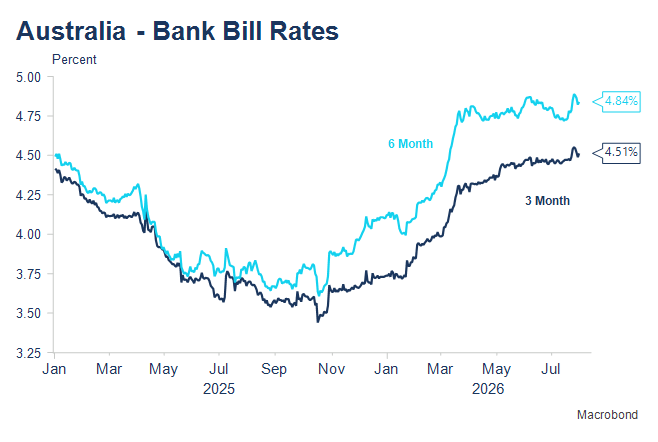
Second, markets significantly reduced the probability of a further rise in the Australian policy rate such that now less than a 50% chance of a rate increase is priced by year end. With US interest rate markets still factoring two interest rate increases by early next year, US rate expectations to an extent are diverging from those in Australia. Though perhaps a truer description might be that US interest rate pricing is reconverging with Australian short end pricing after the RBA raised rates three times earlier this year.
The main talking point among interest rate managers surrounds the actions and non-actions of new Fed Chair Warsh. When announcing the formation of a communications task force at his inaugural press conference, Warsh was clear that he would be providing far less information for market participants. In part this reflected his views that over-communication had resulted in a situation where markets were merely pricing what the Fed was communicating. His preference is for markets to provide signals for the Fed, based on markets’ interpretations and analysis of the economic data. In effect, longer-dated bond yields will more purely reflect the markets’ combined interpretation of the latest inflation and economic data.
At last week’s press conference, Warsh described the Fed as in a period of watchful thinking rather than of watchful waiting. The phrase suggested to me the Fed is conducting a significant amount of due diligence on the data and the appropriate policy response. Warsh also noted that the Fed’s balance sheet might be part of a policy response in the latter part of the year. Together with no change in policy at the meeting, this had the effect of producing a significant sell-off in US longer-dated yields, even as short end yields fell a little as very near-term rate rise expectations were pared a little. That said, the market continues to price a 72% chance of a rate rise in September (106% last week), while a move by October is fully priced and two rate increases are fully priced by early next year. That compares to previous peak pricing of nearly two and a half rate rises at that time.
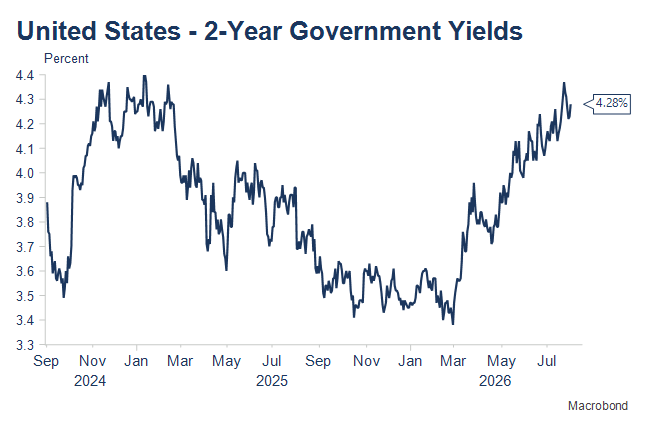
There was a fair degree of disagreement about the likely outlook for Fed policy in the wake of this second press conference, with some market participants suggesting Warsh will simply letting the US long end do the tightening work for the Fed. My take was slightly different. I see the Fed (and Warsh) in the process of gathering information about what it should do with US monetary policy, including watching market signals.
While the removal of forward guidance is confusing for those addicted to Fed speak, with US longer-term interest rates rising it seems more likely that the FOMC will interpret this as a market signal that it should tighten monetary policy. A move in September (previously by September) and December remains my base case, though at this stage the arguments of even tighter US policy than this recalibration are not especially strong. That said, my medium-term expectation also remains that the demand-driven pressures emanating from the AI investment boom will lead to a long, slow US tightening cycle, as has occurred in other investment booms.
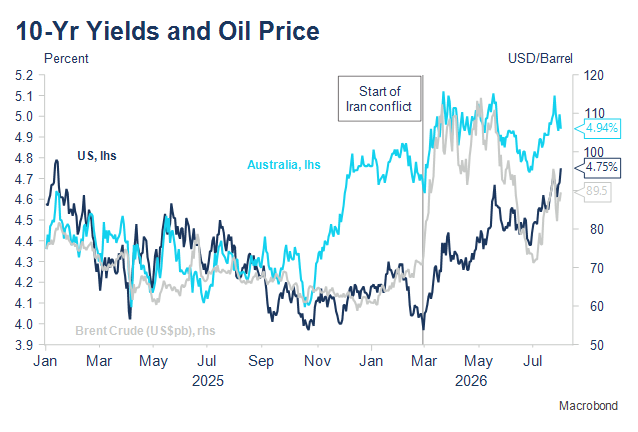
At the same time that US longer-term yields were rising, (unusually) Australian yields rallied strongly in the wake of the RBA Governor’s speech last Tuesday and a slightly lower than expected Q2 CPI outcome. The Governor’s speech suggested to market participants that the RBA Board was more likely to continue to monitor incoming economic and inflation data at the August Board Meeting next week. That sentiment was reinforced, and tightening pricing reduced to close to zero from a 40% chance last week, following the publication of a 0.8% q/q trimmed mean CPI outcome for Q2.
The latter was below the RBA’s and markets’ forecasts and along with the Governor noting that unemployment had been higher than forecast and the housing market weaker than expected, saw Westpac’s economists join the other three major banks in forecasting that Australian interest rates had now peaked with the next move likely to be a cut, albeit not until next year.
There remains an unusual divergence in Australian market economists’ forecasts, with sizeable numbers of economists in two camps; those expecting further tightening and those expecting the next move to be an interest rate reduction. I remain in the camp expecting the next move to be a tightening, but not until later this year or even early next year. The RBA continues to exhibit a bias to tighten, with the Governor’s speech also noting the RBA had been surprised in the strength of data centre construction, while Assistant Governor Hunter continued to sound concerned about inflation.
Our scenario remains that the AI investment boom continues to produce some demand-driven inflation pressures globally in construction, memory and semi-conductor prices, copper, electricity and water. These add to the supply-side effects from the Middle East conflict, though the latter of course could reverse at relatively short notice if the conflict is resolved. Nevertheless, even a 0.8% q/q inflation outcome, while better than expected this quarter, is not acceptable relative to the RBA’s 2.5% target over the medium-term. 0.6% quarterly out-turns are required.
It was also notable that several economists and commentators were quick to conclude that the lower-than-expected Q2 outcome meant pass through inflation risks had reduced. With Australian governments having quickly enacted a 32c per litre fuel subsidy in Q2 and oil prices having fallen sharply through June, these developments and the generally less febrile pricing dynamic than during and in the wake of the COVID pandemic, make it more likely that these effects are delayed rather than not coming. These pressures should become clearer in July and August price indicators.
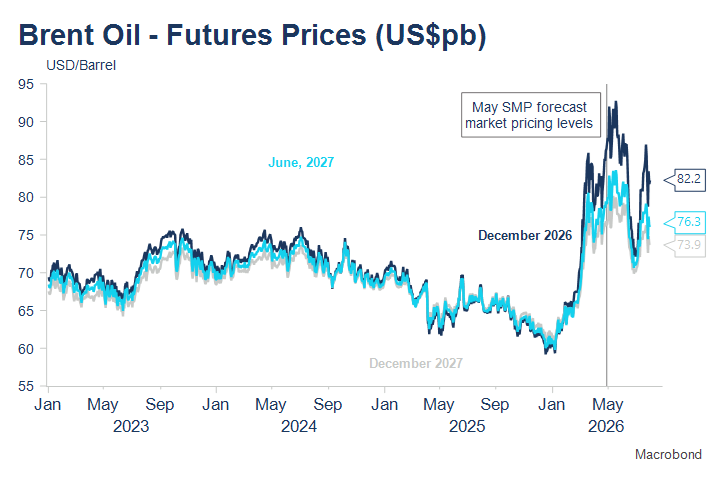
Oil prices had a topsy turvy week, having risen sharply through much of July as hostilities recommenced, but improving a little last week as the US holds off on further significant military action for now. Encouragingly, there were reports the US has pulled off a significant deal for Hamas to disarm.
The week ahead – ISM employment and inflation indicators key along with ANZ job ads. Payrolls may be affected by the World Cup.
The first week of the month is usually an important one for US data, with both ISM surveys and non-farm payrolls and unemployment data released. Other indicators of the US labour market are also published. With forward guidance removed, and three FOMC voters last week dissenting in favour of an immediate interest rate rise, speeches from five Fed officials will be closely watched for any further insight into the debate as to whether the signal of the long end is important or the long end is being left to do the Fed’s job for it.
In Australia, it’s a relatively quiet week, with only the first inflation gauge for July, the important ANZ Indeed Job Ads and the June and June Quarter Household spending data released. Previews and charts follow the calendar below.
All times shown are AEST.
Monday 3 August
- Bank holiday Sydney
- Melbourne Institute Inflation Gauge – July
- 12:00 midnight – US Manufacturing ISM
Tuesday 4 August
- 11:30am ANZ Indeed Job Ads – July
- 11:30am Household Spending Indicator – June and June Quarter
- 12:00 midnight US JOLTs Survey
Wednesday 5 August
- 08:45am NZ Labour Market Data – Q2
- 10:15am Fed’s Schmid on Monetary Policy and Economic Outlook
- 12:00 midnight US Services ISM
Thursday 6 August
- 06:05am Fed’s Cook on the Economic Outlook
- 07:30pm US Challenger Layoffs
- 10:35pm Fed’s Daly Keynote Address
Friday 7 August
- 07:30am Fed’s Musalem speaks
- 10:30pm US Non-Farm Payrolls and Unemployment Rate
- 12:00 midnight Fed’s Barkin speaks
ISM Surveys
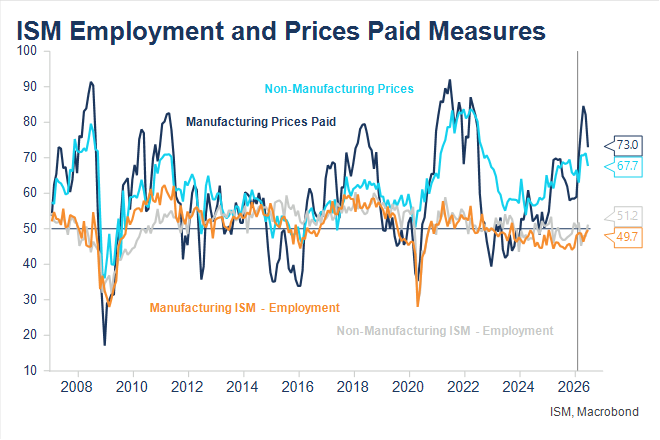
I have been following these series closely since the Liberation Day tariffs were announced. They provide important guidance as to the impact of tariffs and the Middle East on both prices and employment intentions; the two elements of the Fed’s dual mandate. There are a few important aspects to the chart: 1) both inflation and employment were strengthening ahead of the Iran conflict, suggesting a shift towards tightening; 2) while price pressures reduced somewhat last month (but still remained strongly tilted toward price rises), the most interesting aspect was a rebound in employment. I had expected this to lag further, though perhaps there may have been some World Cup effect. Either way, at this stage, both elements are tilted toward the need for the Fed to soon decide that some firming in monetary policy is desirable, especially if it reads the signal of the long bond yield in the same way as I do! As always, I recommend reading the comments from respondents to the survey in full for a great, close to real time read on the US economy.
Non-farm Payrolls and Unemployment
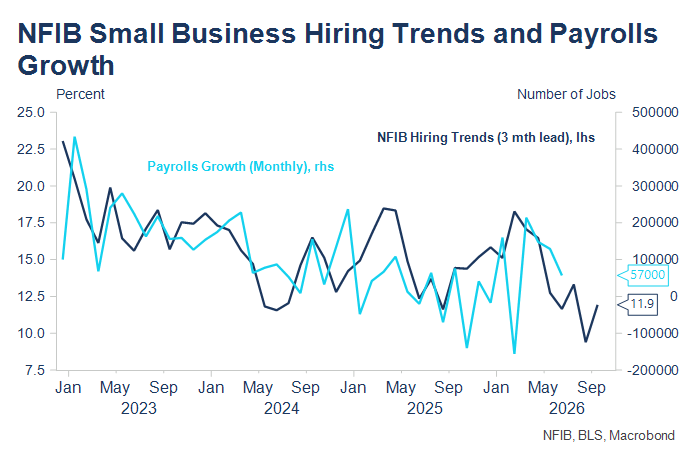
Just as the employment indicators from the ISM had improved ahead of the Iran conflict, non-farm payrolls had improved a little in the early months of the year. The NFIB series also provided that signal ahead of the Iran conflict, though the series subsequently weakened and correctly signalled the downside risk to payrolls that resulted last month. The NFIB series again suggests a relatively soft payrolls print this month, with some downside risk to the market forecast of +85K, though I am a bit wary of the possibility that the Football World Cup might have boosted payrolls in July. For me, the key will be the extent to which the NFIB series recovers in coming months now that oil prices have eased to less extreme levels. That will determine whether payrolls growth restrengthens as I expect, reflecting the strong AI investment dynamic.
ANZ Indeed Job Ads
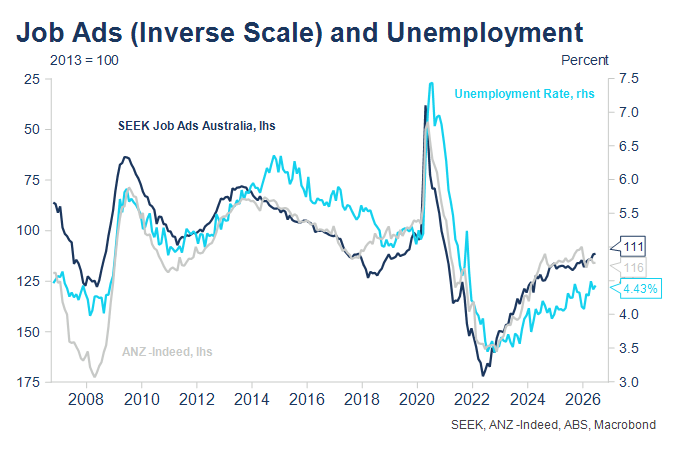
Job ads, along with the NAB Business Survey, remain my two favourite indicators of the Australian economy. The SEEK Job Ads series has declined modestly since the Iran conflict began but was unchanged in June. That message – an important one for interest rates if sustained – has not been confirmed by the ANZ Job Ads series. July data on Tuesday will be important to watch, therefore.
Household Spending Indicator
The HSI surprised sharply to the upside in May after a softer than anticipated April print, that in part reflected war-related travel refunds. The market is looking for a relatively soft +0.2% rise, no doubt reflecting the strength of the previous month’s result. The risks seem to again be on the upside as June has been benefiting from greater appetite for End of Financial Year sales in recent years and the May result corrected for April weakness. A stronger than expected outcome would be unlikely to change views much about the RBA’s August Board Meeting, however, it may see some reassessment about the potential for a tightening in September or November.