Key points
- The economic calendar suggests a very quiet week ahead, though technology share prices may not conform to this script. US data is second tier, and the Fed is in communications blackout ahead of the October 27-28 FOMC meeting. The US market is following the recent guidance of Fed officials more than the inflation data in pricing only a small chance of an interest rate rise at this month’s FOMC meeting.
- This leaves RBA Deputy Governor Hauser’s Wednesday morning appearance as the key event for the week. Hauser has been a very clear communicator of the RBA’s current thinking, having previously clearly signalled the strong likelihood of the September interest rate rise. It will be particularly interesting to see how he read last week’s unusual and weak labour market data, and to see whether the RBA’s recently upgraded resolve to reduce inflation remains in force.
- Fed Chair Warsh described the AI spending pipeline as massive and the impact on prices as a surge, when he was interviewed in Bangkok on Friday. This suggests continuing upward pressure on US interest rates – and more than FOMC participants currently anticipate.
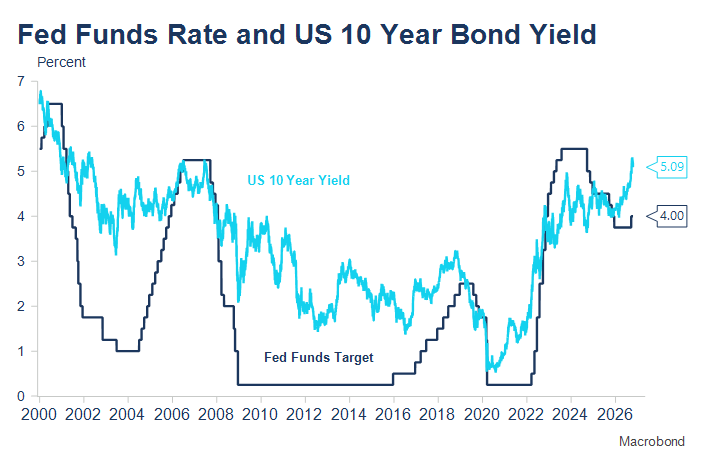
- But the US long bond – already discounting around a 5-5.25% peak in the cash rate – suggests greater market movements might occur at the shorter end of the yield curve in the coming period. A likely continuing correction in technology share prices may be a factor in coming weeks.
- With it being such a quiet week, I’ve taken a leaf out of Fed Chair Warsh’s book and decided to “look out the window”. The RBA should probably do more of this – I continue to see the Bank as placing too much faith in its modelling, which is not sufficiently robust to handle the size and variety of shocks currently being experienced.
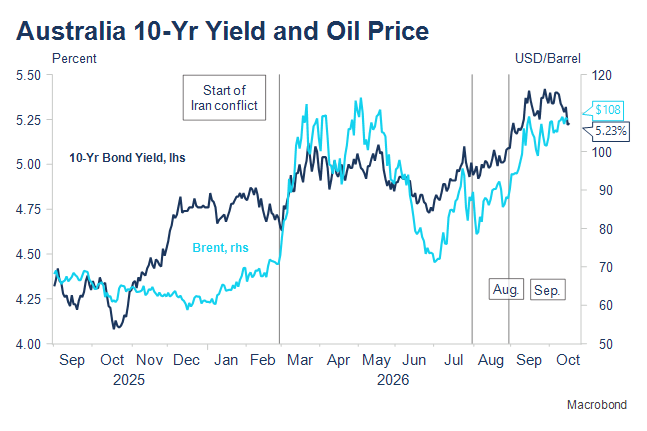
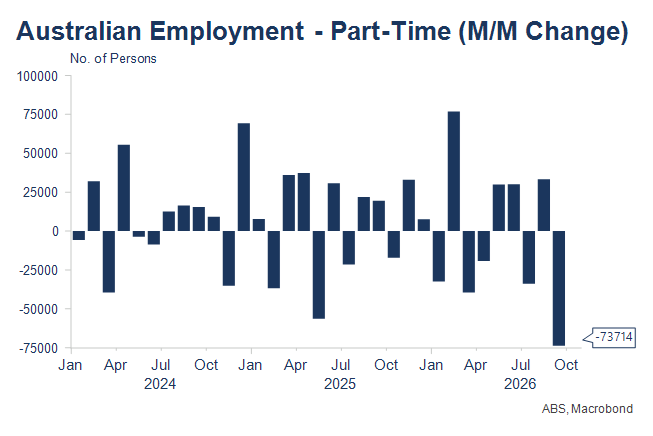
- Looking out the window, it is clear: Australian and US inflation remain too high. Recent much higher oil prices and AI related impacts are contributing to ongoing inflationary pressures; both the Fed and the RBA are likely to tighten further (more so in the US than Australia. However, the Australian market is now not discounting sufficient tightening with less than one further move priced); and the weakness in Australian labour market data in September is likely overstated. The concentration of the falls in employment in NSW and part-time employment are telltale signs of volatility in this already very volatile survey. With the ABS modernising the survey, this suggests the data is likely more noise than signal.
Australian and US key events calendar
Times shown are AEDT, noting there is a Federal Reserve communications blackout until the FOMC Meeting (27-28 October).
Monday 19 October
- 10:05am RBA’s Kent Fireside Chat
Wednesday 21 October
- 8:45am NZ Q3 CPI
- 09:30am RBA’s Hauser Appearance
Thursday 22 October
- 11:30pm Initial Jobless Claims (200K expected, previous 199K)
Friday 23 October
- 11:30am S&P Australian Composite, Manufacturing and Services PMI
The week ahead
The very light calendar this week shapes up as one of the quietest on record from an economic perspective, though developments in technology share prices may not comply with that script following recent significant corrections. There are only second-tier US releases on housing and regional Fed surveys and with the Fed in communications blackout until the 27-28 October FOMC Meeting. The RBA appearances of Chris Kent and more importantly, Deputy Governor Hauser on Monday and Wednesday are likely to be key.
I continue to find Deputy Governor Hauser’s public appearances illuminating. He calls it like it is. His 7.30 Report appearance last month clearly signalled the likelihood of the September tightening. He will remain concerned about inflation. The greatest interest will therefore be in how he interprets last week’s very unusual Australian employment and unemployment data. I have considerable reservations about that data (more on that below) and would expect the RBA to as well.
With such a light calendar, we can take some time to – as Fed Chair Warsh recently described – “look out the window”.
Looking out the window: US tech stocks, Australian and US inflation, the upcoming FOMC and RBA Meetings, Australian September labour market data
US tech stocks
The bond and equity markets appear to have spoken. Both the failure of the Firmus float and the very significant markdown in the prices of CoreWeave shares and debt likely signal the market imposing a higher cost of capital on AI investment. This will likely limit the quantum/pace of AI investment spending and will probably also see the recent correction in technology share prices continue in the short-term.
This however does not mean that there will be a very dramatic scaling back of overall AI investment. The competition between companies and countries for AI leadership remains intense, which will maintain a considerable pipeline of spending. This will be an ongoing source of support for economic growth, particularly in the US, as well as an unwanted additional source of inflationary pressure. Chair Warsh described the AI investment spending pipeline as massive and the impact on related prices as a surge, when interviewed in Bangkok on Friday.
Australian and US inflation
Both remain stubbornly above target, with this week’s US CPI continuing to show over 50% of the items running at an above 3% y/y rate (one of the Fed Chair’s metrics for gauging progress toward target). The US September PPI result was also roughly double market expectations which suggests the September core PCE will print in a still very elevated 0.3%-0.4% m/m range.
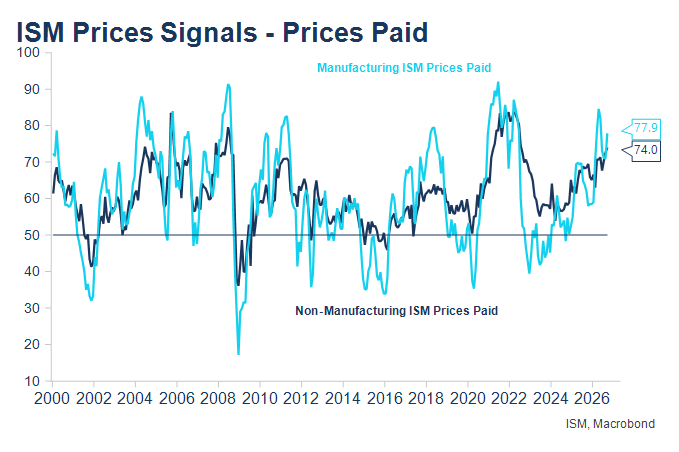
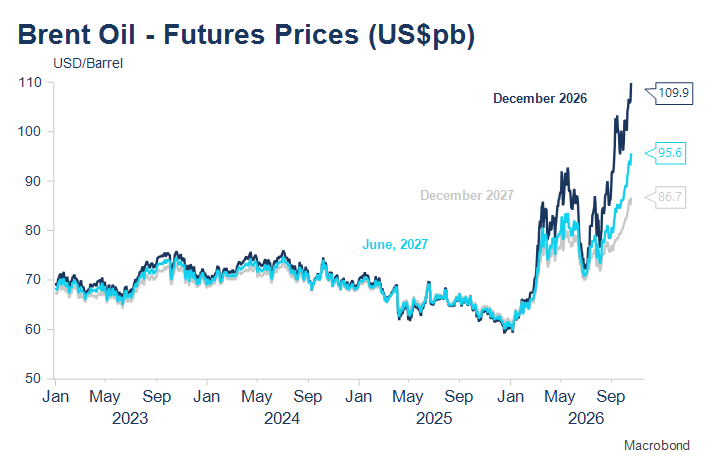
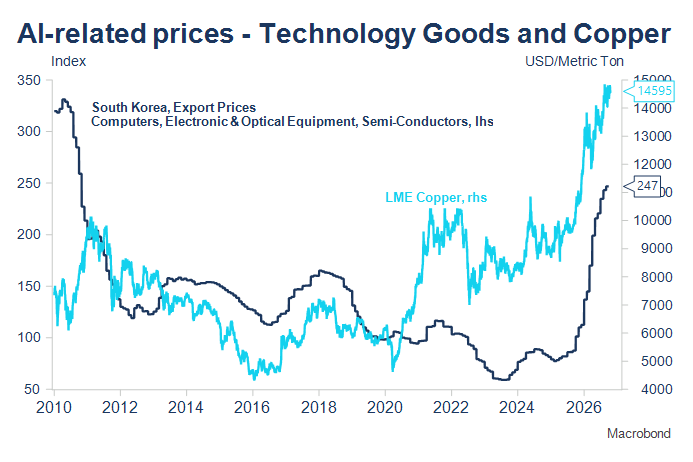
Higher oil and technology goods prices continue to be evident in both the ISM prices series and also in other more direct price measures. Importantly – and correctly – Warsh describes the latter as demand pressures, which of course can be impacted by traditional monetary policy settings. There remains a question as to the extent the AI investment spending pipeline can be influenced given the importance of the new technology. However, sometimes during investment booms the role of higher interest rates is to “make room” by squeezing other elements of demand (such as housing), and by also weeding out some of the more speculative planned spending.
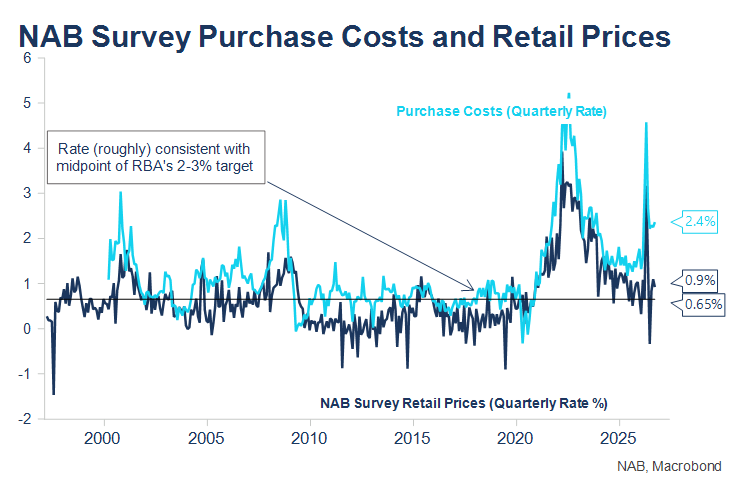
Australian core inflation also remains stubbornly above target at around 3.5% y/y. A similar calculation to the Fed Chair’s also shows an equally large percentage of the index running above not just 3% y/y, but above 4% y/y. Australian wages growth also remains faster than the low inflation period of the mid-2010s, while the NAB Business Survey continues to reveal cost and retail price measures are running well ahead of the rate required to hit the RBA’s 2.5% target. This makes it most unlikely that Australian inflation can be returned to target with just one further interest rate rise (only around an 80% chance of just one further move is now priced by markets, which seems too low). To me, continuing elevated inflation – and an upgraded commitment by the RBA Board to return inflation to target – reduces the importance of the weaker September labour force data, even before I question the reliability of that data.
Thoughts on the upcoming FOMC and RBA meetings
The FOMC has entered its communications blackout ahead of the October 27-28 FOMC Meeting. Markets price a relatively low (only 15%) chance of an interest rate rise at this meeting but fully anticipate a further rise at the December meeting. This pricing seems to more reflect the recent guidance of Fed officials than the inflation data or pressures, which have continued to run hot. Many influential Fed officials including Williams and Waller have signalled a preference for not raising interest rates at successive meetings, but also that a further rise in December is likely.
The themes (and choice of words) in Warsh’s Bangkok speech suggest that the Chairman may be the most hawkish of any FOMC member at the present time. Certainly, his comments suggest more needs to be done to achieve prices stability. With several other members also remaining hawkish, this suggests the presence of a number of dissents in October in favour of an immediate further tightening. I suspect the Chair – as in July – will signal an important inter-meeting period for data, ahead of what’s likely to be the next move at the December meeting.
The more important question is how much further tightening is ultimately required after a likely December move. Markets now price two further rises. This compares to the recent dot pot where the FOMC only had eight of the 18 members predicting a third interest rate increase and none predicting more than three. The inflation prints – and a likely near-term acceleration in US employment growth – suggests the FOMC still has some way to adjust its expectations on what’s likely to be required.
Australian markets have also reduced the pricing of a likely move by the RBA at its November meeting (now only around a 20% chance). I altered my probabilities of a November move following the Governor’s press conference. The latter was more dovish than I had expected. Last week’s Minutes read more hawkishly, which is usual after the RBA has just tightened policy. My strong view remains that the RBA has not finished tightening (because Australian monetary policy is not yet tight enough to return inflation to 2.5%) and that any early return to an easing cycle is very unlikely courtesy of the AI boom.
The November forecast update is complicated somewhat by the release of the higher-than-expected unemployment rate in September. That will necessitate an upgrade to the RBA’s unemployment forecasts, which previously only reached 4.7% in December 2027. A headline-grabbing 5% unemployment forecast in 2028 is quite probable. At the same time, a 0.9% or 1% q/q trimmed mean CPI for Q3 and higher oil price assumptions will see the inflation forecast sustaining uncomfortably high levels, with a delayed return to target likely without further policy action. That’s likely to see the Bank continue to warn of the risk of further policy tightening being required.
September labour market data
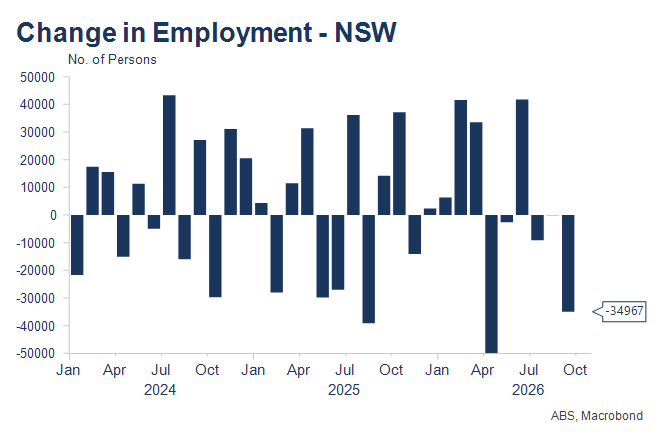
Last week’s labour market data – and my interpretation of the data – has sparked some vigorous debate among economists. The presence of some telltale unusual movements in the data – the big drop month-on-month, the fact that this was concentrated almost entirely in NSW, and the huge drop in part-time employment (a most unreliable part of the survey), all at a time when the Bureau is modernising the survey – make me question the reliability of these signals.
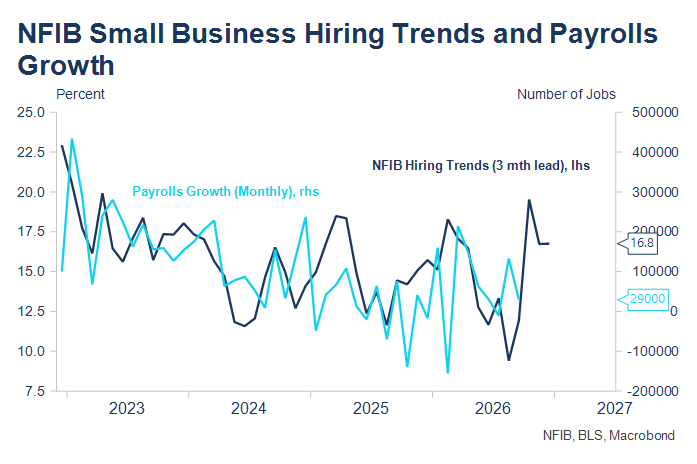
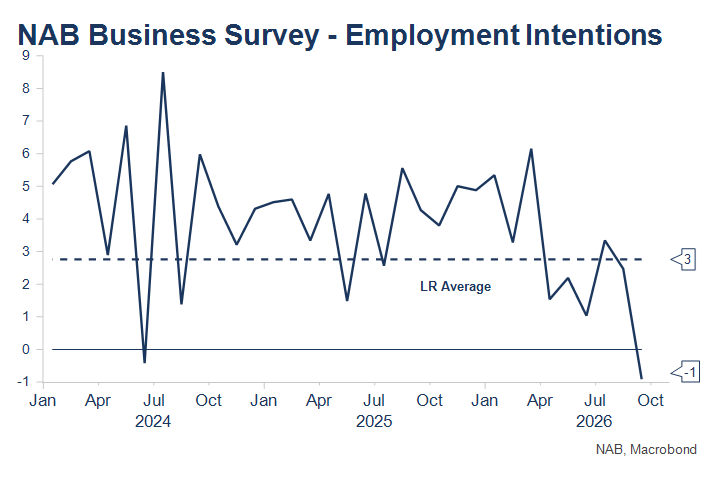
Others have noted the recent weakness in the NAB Business Survey employment question. If sustained, that clearly signals slower employment growth ahead, however, the drop recorded in the September NAB Survey is too early to have impacted the September labour force data, which pre-dated the NAB Survey.
Bond market developments and outlook
Weakness in technology shares has contributed to a significant correction in bond yields over the past week. This has occurred even in the face of still higher oil prices, stronger US CPI and PPI data, and continuing high copper and technology prices. As noted in previous weeklies, it’s often the case that the US 10-year yield peaks around the subsequent high in the Fed funds rate. It could be argued current pricing is already consistent with a 5-5.25% peak in the Fed funds rate, which seems reasonable at the current juncture. I’m expecting longer bond yields to range trade, while shorter-dated yields ebb and flow around a still gradually rising short-term interest rate structure in both Australia and more so in the US.