Key points
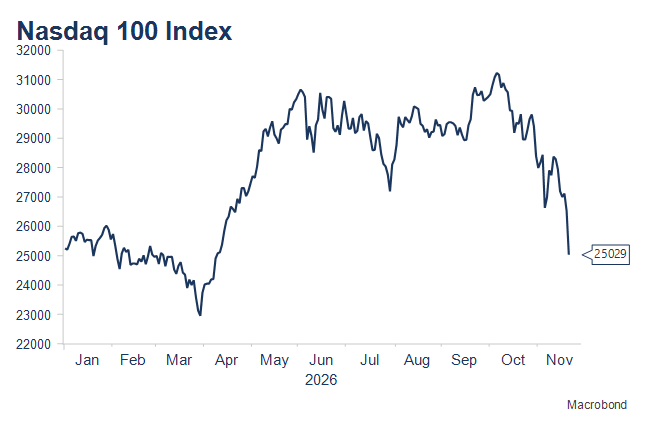
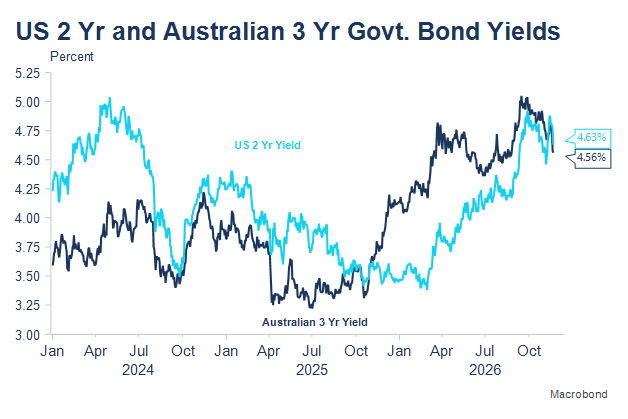
- Continuing dramatic falls in technology share prices, including a 5.6% drop in the Nasdaq on Friday, have been the dominant force in global bond markets over the past week. This has led to across-the-board yield declines, big drops in copper and semiconductor prices and reductions in the amount of tightening priced into both Australian and US central bank curves over the second half of next year.
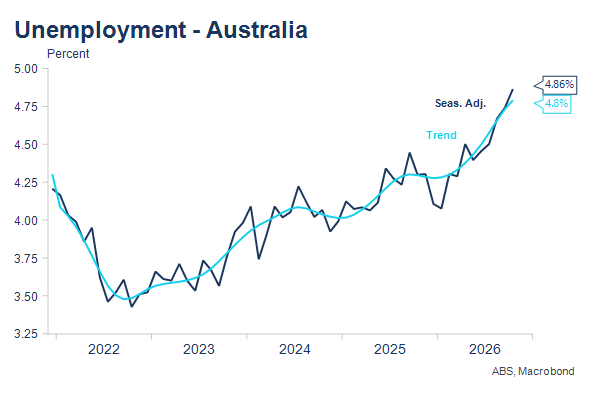
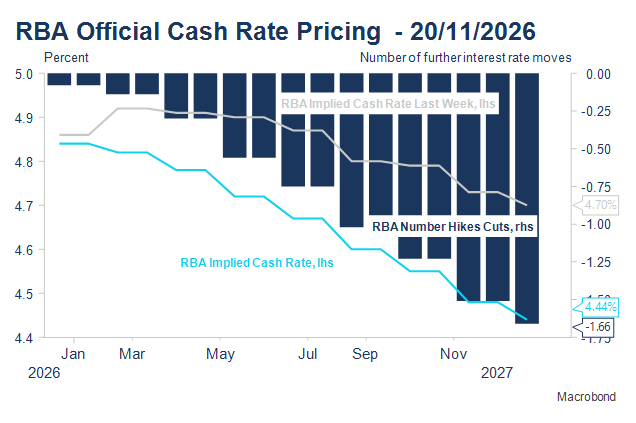
- Australian interest rate markets now price a full 25bps interest rate cut by the August 2027 Board meeting. This was after October employment data surprised sharply on the soft side for the second consecutive month. The unemployment rate rose to 4.9%, a level the RBA did not forecast until H2 2027.
- A detailed look at the Australian labour force data continues to raise some concerns about the veracity of the signal in the latest data. My most favourable interpretation is that the data signal the labour market has not been strong as earlier reported, rather than concluding that significant numbers of jobs were lost in both September and October.
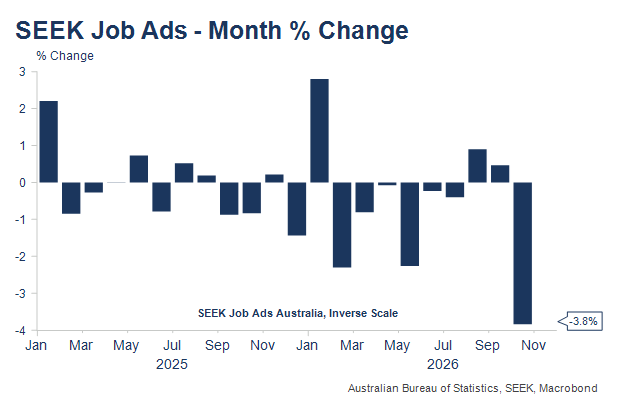
- SEEK job ads, however, were very weak in October (dropping 3.8% m/m). The fall was effectively before the impact of the two recent interest rate rises by the RBA. This, plus a number of recent job loss and offshoring announcements reinforces the view that the RBA will remain firmly on hold in coming months and that the likely peak for Australian cash rates may well have been reached.
- Australian markets will likely continue to price with the RBA having a bias to ease rates. While the latest employment data support those on the Board that did not want to tighten in November, equally, this week’s high core CPI print is likely to support the six Monetary Policy Board members that thought further tightening was justified. The best core CPI forecasters in the market are predicting a +0.4% m/m increase. That’s above the market median forecast of +0.3%. That seems the clear risk to me given the rise in oil prices since mid-July, the changes to credit card surcharging and the calendar quirk that sees core inflation print higher in the first month of each calendar quarter. As a result, I’ll continue to fade pricing for any very early interest rate reductions by the RBA.
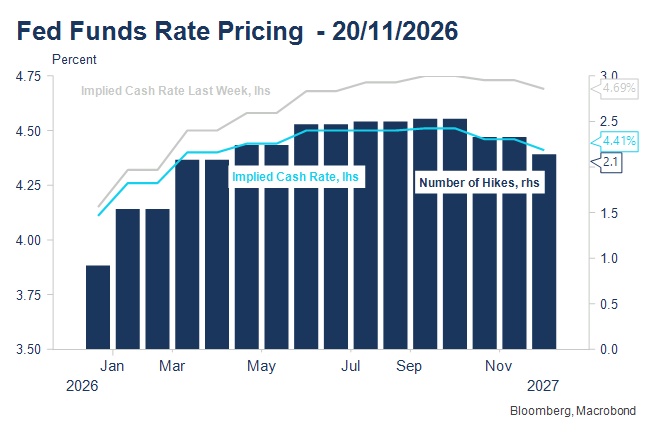
- In the US, interest rate increases appear to remain very much on the table, with Fed commentary remaining hawkish (Governor Waller is still talking 50bps in December, while Governor Cook noted there is a cost in delaying a decision to tighten when a policy move is clearly required). This suggests a larger 50bps move in December cannot totally be ruled out, though technology stock weakness probably now makes that unlikely. NY Fed President Williams speech at 8am on Tuesday will still be well worth watching.
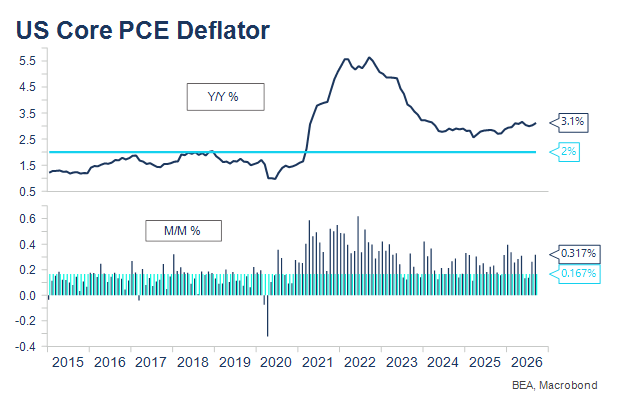
- In other US news, the core PCE prices index seems likely, like the core CPI, to print the third consecutive 0.3% m/m increase. That’s clearly trending in the wrong direction. Some unwind of the AI boom and associated pricing, together with lower oil prices – in spite of tensions remaining elevated – reduce but do not remove the need for further tightening. The Fed also releases the December FOMC Meeting Beige Book on Wednesday night before US markets close for Thanksgiving on Thursday.
Recent developments in interest rate and bond markets
The past week has seen another very significant repricing in interest rate expectations for both the US and Australia. Two developments explain the moves. First, the continuing rout in technology share prices globally as markets continue to factor a slower pace of AI investment rollout after the midterm elections and tighter restrictions over US chip technology. The Nasdaq finished the week down over 10%.
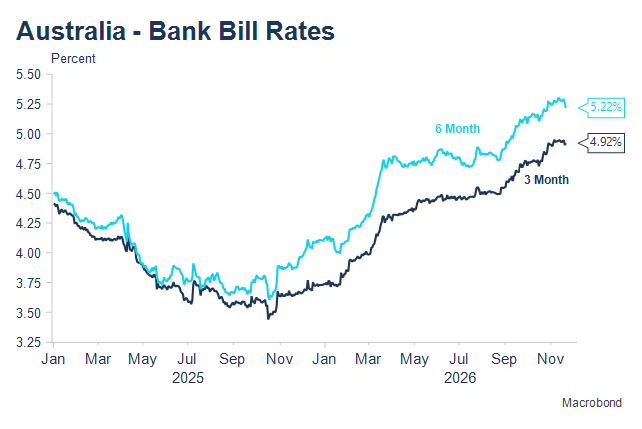
Second, Australian labour market data surprised sharply to the downside in October. This was the second consecutive such downside surprise. I’ll investigate how reliable this data is a little later in the report. However, with the positive backdrop for bonds from US technology stock developments, the data led to a considerable repricing of the Australian yield curve and short end interest rate expectations. The Australian market has flipped to now pricing rate cuts, including small chances at the next few meetings. A full 25bps rate cut is priced by the August 2027 meeting with one and two thirds interest rate cuts priced for the end of 2027.
US interest rate pricing continues to reflect the likelihood that the Fed will raise rates in December and again by March, though a full further interest rate rise has been removed over the past week from pricing expectations for the second half of 2027 given the sharp decline in technology stocks. Governor Waller continues to advocate for a 50bps tightening in December (the FOMC Minutes revealed one other Committee member also suggested a larger move should be discussed in December). Given the delay in making what is a very obvious move, there would have been a pretty strong argument for a larger move, though recent stock price weakness likely argues against this now occurring.
Australian and US key events calendar
The week ahead is mainly all about the two inflation releases on Wednesday on opposite sides of the Pacific, though Fed Governor Williams delivers an important keynote address around breakfast time on Tuesday. I see upside risks to the 0.3% m/m forecasts predicted for both the Australian monthly core CPI and the US core PCE prices index. Australia also receives a couple of partial indicators of Q3 GDP, (the latter published next Wednesday), while US markets are closed for the Thanksgiving holiday on Thursday. There are few Fed speakers on the calendar apart from Williams, before the Communications Blackout begins on Sunday. The Beige Book for the 9 December FOMC Meeting is released at 6am on Thursday.
(Times shown are Australian Eastern Summer Time)
Monday 23 November
- 09:00am S&P Flash Manufacturing, Services and Composite PMI for Australia (Nov). [I don’t find these surveys as useful as the NAB Business Survey].
Tuesday 24 November
- 01:45am S&P Flash Manufacturing, Services and Composite PMI for US (Nov).
- 08:00am Fed’s Williams keynote address
- 11:00am AOFM tenders $1bn 3.75% 2037 bonds
Wednesday 25 November
- 11:30am Australian CPI (October). Headline CPI expected +0.4% m/m, +4.8% y/y, previous +0.8% m/m, +4.3% y/y. Core CPI expected +0.3% m/m, +3.6% y/y, previous +0.3% m/m, +3.6% y/y. [The best core CPI forecasters are at +0.4% m/m].
- 11:30am Construction Work Done (Q3). Market expects +0.7% q/q, previous -2.1% q/q. [Volatile due lumpy data centre and associated renewables work].
Thursday 26 November
- 00:30am US PCE Price Index (October). Core PCE expected +0.3% m/m, +3.2% y/y, previous +0.3% m/m, +3.3% y/y.
- 06:00am Fed releases Beige Book
- 11:00am AOFM tenders $150m 2.5% 2030 linkers
- 11:30am Australia Private New Capital Expenditure (Q3). Market expects +4.3% q/q, previous -3.6% q/q. [Volatile due lumpy data centre and associated renewables work]. 2026-27 Expected Capex Spending $211.5bn.
- US Thanksgiving Holiday – bond and equity markets closed
Friday 27 November
- 11:00am AOFM tenders $1bn 1.75% 2032 bonds
Sunday 29 November
- Fed’s external communications blackout period commences ahead of 9 December FOMC Meeting
Detailed data previews
Australian monthly CPI
There are a lot of moving parts affecting monthly headline and core CPI forecasts this month. Petrol prices (+8.4%) are again expected to have a significant impact on the headline CPI as well as impacting other categories such as communications (couriers) and domestic air travel reflecting the reimposition of fuel surcharges. The key question will be whether food prices will also be impacted after relatively modest readings in recent months, again due to higher transport costs. Many fruit and vegetable prices are much higher in November.
There is also considerable uncertainty about whether the end of credit card surcharging on 1 October will produce a noticeable impact on the prices of some items this month. There were reports of firms in the hospitality sector raising prices to compensate for the merchant fees they are charged but are no longer able to pass on to consumers. To the extent that there was some effect, this may bias both the core rate of inflation and the market services component higher in the month, though this would be a one-off effect that should be looked through by the RBA rather than a true acceleration in the core rate of inflation.
The better CPI forecasters in the market are predicting a +0.4% m/m core CPI increase in October and that would be my assessed risk given the considerable rise in petrol prices since mid-July, the change to credit card surcharging and the peculiar quirk that tends to see the trimmed mean CPI print higher in the first month of each quarter.
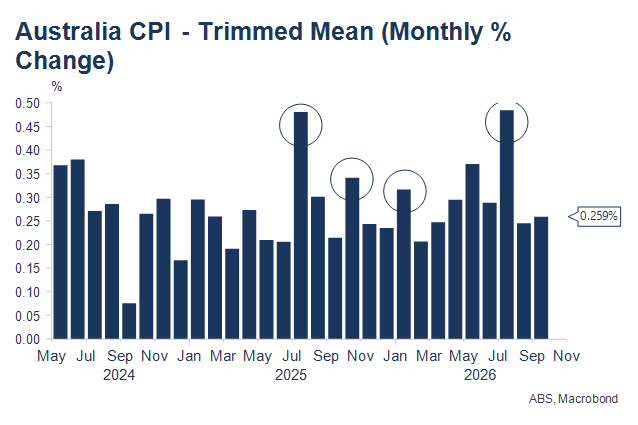
Restraining the CPI this month should be the operation of the Commonwealth Rental Assistance Scheme and ongoing discounting for the really big ticket items (newly constructed dwellings and new cars).
US Core PCE Price Index
In the US, after the third successive 0.3% core CPI print, the market expects a 0.3% core PCE price index to be recorded for October (released at half past midnight on Thursday morning). That would extend the run of consecutive 0.3% m/m increases to three, which clearly leaves the core PCE prices index trending higher rather than trending back to the Fed’s 2% target in a timely manner.
For me, the puzzle has been why the Fed has been dawdling in tightening US monetary policy further given clear inflation trends away from target, starting from an already above-target level. Strengthening signs in US labour market data appear to clearly reinforce the need. The new Chair may already to an extent be following his favoured six policy meetings a year agenda, by considering data trends at slightly longer timeframes than single intermeeting periods. One consequence of longer intermeeting periods would be the likelihood that policy may be adjusted in larger quanta than when more regular FOMC meetings occur. That might mean an outsized 50bps move might still be possible in December given inflation is clearly moving in the wrong direction for the Fed, though the weakness in US technology stocks likely makes that larger move unlikely.
Special focus: how believable are the recent Australian labour market data?
That’s pretty much the $64 million question for Australian interest rate markets at present. I’ve taken a detailed look at the data and the most bullish (for interest rates)/bearish (for the economy and labour market) interpretation I can come up with is that the latest data suggests employment had not been growing as quickly as previously assessed during the middle part of the year, rather than significant job losses occurred in September and October just ahead of the RBA’s latest two interest rate rises.
This can perhaps be seen most obviously in the chart below, which shows the significant volatility in both the participation rate and employment in recent months. The fall in employment and participation perhaps mainly unwinds the very large rise in both measures recorded in June this year (when employment grew 75,000).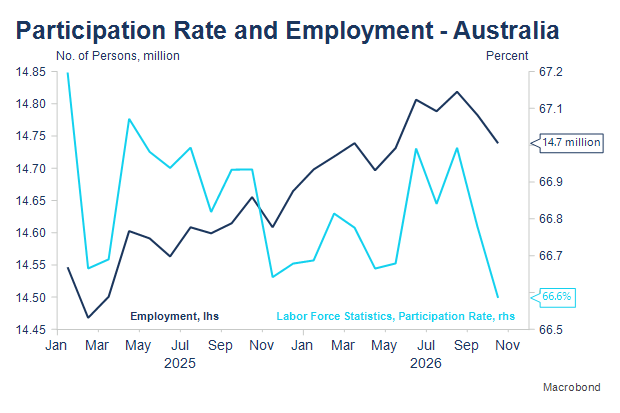
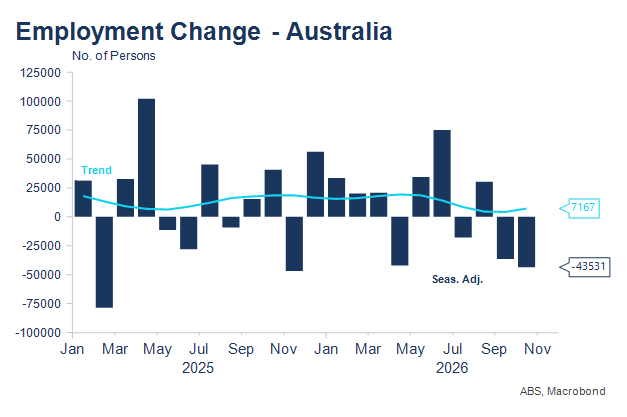
Other aspects of the report also create some concern for me about the reliability of the signal – the declines in employment are concentrated in part-time employment, which has fallen 2.5% over the past month (normally part-time employment rises in downturns); NSW employment has also been particularly weak, while other weaker states such as Victoria have not seen employment weaken.
These developments suggest that it’s possible the market may still see a surprising bounce back in the employment data in one of the next two months. More worryingly for the medium term outlook, SEEK job ads declined by a large 3.8% m/m in October. And Woolworths, NAB, Qantas, Wesfarmers, Canva, KPMG and David Jones have announced a number of recent job cuts and offshoring moves. Together these seem likely to contribute to slower employment growth in the period ahead and the looser labour market that is required to deliver wages growth consistent with 2.5% inflation.
Bond market outlook
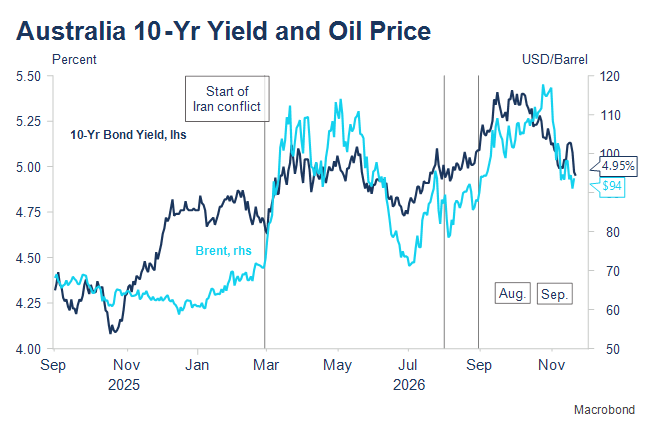
The economic outlook and bond market strategy for the past year has mainly been about assessing the combined influences of the AI investment boom and the Middle East conflict. These influences have been divergent on activity but reinforcing on inflation. Both have seen significant developments in recent weeks, though the decline in oil prices may more reflect the downstream effect of the fall in technology share prices and assumed slower pace of AI rollout, rather than any particular lessening in tensions in the Middle East.
These developments support lower bond yield pricing than a few weeks ago, even as further monetary policy tightening occurs in the US. Looking ahead, increasingly, the lagged effects of previous Australian and US interest rate rises on activity as 2027 progresses also needs to be considered. This also suggests Australian interest rates are close to peaking, if that has not already occurred. However, with the Middle East as yet unresolved, oil prices still very elevated, considerable AI spending still on the cards and central banks having become more serious about finally returning inflation to target, it still seems unlikely that there can be any early interest rate cuts under contemplation in Australia.